Showing posts with label 2013 Outdo Yourself Reading Challenge. Show all posts

Sunday, 4 August 2013

World War Z by Max Brooks


This book had me hooked at the beginning. I was fascinated and horrified by the descriptions of cities fighting off millions of zombies, zombies filling the ocean, and how each country had different weapons and strategies. This book is a description of hell on earth.

Notice I said "book" not "novel." While the book is a well, written piece of fiction it is not a novel. Each interview reads more like a flash fiction short story. Sometimes the story is cut off abruptly just as it is getting good. There are no main characters. No real plot or storyline to follow.

There's also very few stories about civilians. This is what frustrated me the most. While I enjoyed reading stories about how the different militaries from different countries fought hordes of zombies, I would have liked to have read some stories about how civilians fought the zombies. The military jargon gets tiresome after awhile.

I also would have liked Brooks to have gone more into depth about which countries survived, which ones merged together, how society, government, culture and ecology changed. These were touched on but never discussed in depth. The only animals discussed were the dogs that were used to hunt zombies, the sabertooth like cats, turtles "that were as rare as unicorns," and how the zombies decimated ocean life.

What did like was how diverse the stories were. I expected the book to focus on how the United States fought the war but instead there are stories from every area of the globe. While the culture and politics was portrayed well, many characters lacked their own quirks and speech and were indistinguishable from another.

And lastly, why the heck did the American military call zombies Zack? I still can't figure that one out. I understood "G" which was short for ghouls, but Zack? It really bothered me so I Googled it and found the answer. It seems "They were called Zack just as the VC were called Charlie in Vietnam."

Overall I really liked the book. But it was so damn scary that I will definately be reading Brooks' Zombie Survival Guide. You know, just in case.

My rating is a solid  Photobucket

As for the movie, I was really excited to see the movie until I learned that the zombies are different. They are fast. I wonder if the screenwriter got the idea from a passage in the book where one guy worries that nuclear fallout will make the "zombies fast like cheetahs."

Wednesday, 24 July 2013

Inferno by Dan Brown


I was so excited when I saw that Dan Brown had finally written another book. I was even more excited when I found it at the library as a 7-Day Express book. This meant I didn't have to wait weeks in the queue for my turn to have the book.

What I Liked About the Book
I loved the way this book started. You are right in the action. I think Brown's previous books took awhile before they became exciting. This book is a race against time. Langdon doesn't just have to save one person, or even several people. He has to save the entire world. I felt this book could have been titled Robert Langdon: Superhero.

You also couldn't figure out exactly who was the good guys and who were the bad guys. Once you do have some figured out Brown switches them at the end.

I loved the descriptions of the art. I loved imagining what the different settings looked like. I was tempted to look some of them up online but decided not to because I actually think it's more fun to imagine them in my head. Brown is excellent at describing art, sculpture, and buildings so you know almost what they look like. I find my imagination is always a bit better than the real thing.

My favorite part of the book (as is my favorite part of all Dan Brown books) is watching Langdon solve the clues, riddles, and puzzles.

I never once felt Inferno slow down or drag. The pacing of the book kept me interested right up until the very end. I noticed many people complained about the description in their reviews on Amazon and that it slowed the story down but I never felt this way at all.

What I Didn't Like About the Book
Trying to do this without spoilers will be a challenge, but I will do my best.

The bad guy, Zobrist, was a bit cliche. A super rich, mad scientist with a lair? Really? As was the character of Sienna, the genius that just wants to belong and make a difference in the world who is tempted by evil. And I still don't quite understand why she was bald.

The very first clue of the painting where sections were changed around was so boring. If I were Langdon I would have been laughing at how easy it was to solve it. The clue just seemed so amateurish. But then again, Zobrist was a scientist, not an art historian or a symbologist.

I was disappointed by the real reason people were trying to kill Langdon. It was really kind of a let down. I also found the idea that certain settings and people were faked completely unrealistic. The reason for Langdon's head wound was just absurd.

I was absolutely fascinated by The Consortium. I find the idea that a secret organization that helps governments create illusions and create false scandals or cover ups absolutely fascinating. However, when the provost (head of The Consortium) bragged about his part in creating the illusion of WMDs in Iraq, I literally burst out laughing. That "illusion" ended up being an utter failure and sure as heck was nothing to brag about. But maybe in Langdon's universe no one ever found out the Iraq WMDs was total bullcrap.

The virus that is found in the end was completely and utterly unbelievable. Dan Brown needs to stay far away from science fiction because I thought it was the stupidest idea in the entire book. In a way, the ridiculousness of the virus almost ruins the book. I wish so much that I could tell you why I hated the idea of the virus but that would be a spoiler that would ruin the entire book for anyone reading this review.

Overall the book was mostly classic Dan Brown, but the science fiction mixed with cliched superheros and supervillians was just too much for me. I felt like they were comic book characters at times. Although a graphic novel version of Inferno would probably be pretty cool. I also have to admit I love to see a movie version of this book.

Despite the flaws it was a good read and I enjoyed it up until the ending. At the ending, I rolled my eyes several times. I really rate it at about 3 1/2 stars but I will be nice and bump it up to Photobucket.

Sunday, 30 June 2013

Beautiful Creatures by Kami Garcia and Margaret Stohl


I have mixed feelings about this book. At times I felt it was beautiful and insightful, especially about how a person reacts to death, but at other times it felt melodramatic and downright silly. However, that's how teenagers are. As Uncle Mason would say, "Teenagers are so apocalyptic."

I loved the setting of the book. I loved how this little Southern town of Gatlin held so many secrets right under people noses. I loved how the history of the Castors was intertwined with the Civil War. The scenes of the Castor Library, how the Ravenwood house changed, and when the stairs whipped Ethan back. These scenes were so imaginative and I hope the movie gets them right.

This book had me reading for hours wanting to know how it ended. I read over 400 pages in a day. I was physically nervous about whether or not Lena would be claimed for the Light or the Dark. The authors Garcia and Stohl, despite the melodramatic teenage romance, are excellent stroytellers. They kept the suspense up until the very end.

But when I got to the end part of me wanted to throw the book against the wall. The ending was frustrating. Why Uncle Mason did what he did makes no sense. I suppose he was trying to protect Lena from Sarafine but it was pretty messed up. Then again all families are dysfunctional in some way. This was theirs I guess.

I have one question though and I want to read the rest of the books in the series to see if it answers my question. Considering the ending, it makes you wonder why Sarafine and Ridley ended up the way they did. I don't wonder about Larkin. He explains. It's just more fun. Sorry to be so cryptic but I don't do spoilers.

I am tempted to give it three stars because I wasn't crazy about the ending or the melodrama, but because the suspense kept me glued to the book for a almost a whole Sunday, I'll give it Photobucket
Hopefully the movie is as good as the book. There's some potentially really cool scenes. (I also may have read almost the whole book in a day because I've the movie from Netflix for a week now.)

The Movie
It was so bad. I've seen some books ruined by the movie version of them but this was atrocious beyond my imagination. The actors did what they could with a horrible script. My rating Photobucket

Wednesday, 5 June 2013

The Great Gatsby by F. Scott Fitzgerald


The Book
While Jay Gatsby is one of the most memorable characters in literature history, there just isn't much to this novel. Any comparison I make would cheapen it, but the book is simply about "partying." Granted the parties in the Roaring 40's were extremely glamorous, especially Jay Gatsby's parties.

I honestly don't like this book that much. I've read it before and I didn't really like it the first time. It's full of phony, dishonest, and shallow people. The narrator Nick Carraway knows this and shows contempt for everyone, even Gatsby himself. Why did he hang out with people he didn't even like? I'd love to ask the narrator this. 

He also clearly drank more than he leads on because all chronological order is thrown out the window. According to the commentary in my book, many have complained about this. I don't know why. The amount of plot in this novel could fill a Post-it note.

Nor did I realize how much Gatsby says "old sport." When I first read this I was in my twenties and thought it was appropriate for someone almost thirty to say. Now I'm thirty-eight and realize it's a silly thing to say.

At times the book is melodramatic and soap opera-ish. "I'm crying because I've never seen such beautiful shirts." That is possibly the most ridiculous dialogue ever written. The scene where Gatsby, Tom, and Daisy finally confront each other was absurd. I tried the first time to believe anyone would have such a confrontation and I couldn't. I still can't.

Things finally "get real" when there's a tragic accident. And...well...unfortunately if I told you any more there would be major spoilers. The ending of The Great Gatsby is both depressing and enlightening. The ending shows the reader is supposed to feel like these people are phony and shallow. I suppose that's actually what makes this book so brilliant. 

My rating Photobucket

The Movie
Coming soon! I can't wait to see Leonardo DeCaprio utter the words "old sport." Maybe if I get really bored I'll watch the Robert Redford version.

Saturday, 18 May 2013

Louder Than Words by Jenny McCarthy


I couldn't put this book down! I wanted to read the book because my neighbor of several years has a boy with autism. I was hoping to get an idea about what it's like for her to raise him. This book didn't do that because my neighbor boy doesn't have it as severely. I am grateful for that. However, it may be because she puts in the work to make life as normal as possible for him. This book gave me an idea about that work involves.

While some mothers recognize traits of autism almost from birth, Jenny McCarthy watched her son begin to regress around at the age of 2 when he began to have seizures. Reading how her wonderful little boy became a zombie right before her eyes was absolutely heartbreaking.

One thing I love about Jenny is how bold and honest she is. She didn't clean up her language to make herself look better. She didn't pretend to have all the answers. She didn't leave her son to be fixed by the medical industry alone. She admitted mistakes and wrote about the toll having an autistic son took on her marriage.

The way she never stopped searching for answers and helping her son recover was nothing less than heroic. For that the book deserves five stars. Hell, having the courage to write this book also deserves five stars.

However, if I was the poor mother of a child not recovering from autism, I think I would hate this book.
At the beginning of the book Jenny was treated by the hospitals like any other mother in America. She was bossed around by no nothing doctors who put making money over the proper care of patients. She was just like the rest of us parents. I would be giving the staff hell too if that was how I was being treated. (Actually I have when my son laid bleeding from the head and patients with less severe afflictions were seen before him.)

Partway through, Jenny McCarthy stopped being like other average mothers.

No mother I know could drop seven thousand dollars in an instant to fly home or buy tickets for a private jet so they can come home every night. They can't buy a $5000 heart monitor  The mothers I know don't have the money to go to the best doctors in the country. Most of them barely have the money for the medical care of a healthy child, much less a severely ill child. They certainly wouldn't have the money for all the therapy and alternative treatments Jenny was able to give her son. I would bet you even if they have good insurance it wouldn't cover these alternative treatments.

She was able to afford his top of the line treatments even after divorcing her husband and having to pay him half her income in alimony! (I would also love to hear his side of the story.)

There's simply no denying Jenny's son recovered "in the window" because she was able to give her son the best treatment money can buy. I learned a great deal about autism, the causes, and the treatments but I want to read a book by a parent who is like me. I want to read about what it's like for an average parent or better yet, a below average parent, to have a son with autism.

I don't deny that Jenny McCarthy has done a tremendous service to the autism community by writing this book and advocating for autism awareness, but surely she is aware other kids don't recover from autism because their parents can't afford the best care.

At the very end of the book Jenny adds a disclaimer. My child was lucky. Your child may not recover as well as mine did. At no point does she ever admit this is because her son had opportunities average kids do not have.

I was curious to know if this was just my opinion or if it was shared by others. It was defiantly shared by others. Here are some other people who feel the same on Amazon:

"However as a non-celeb mom trying to find ways to deal with autism and not go bankrupt in the process, I had a hard time identifying with Jenny's journey since she seems to have a lot of money to put towards her son's treatment."

 "I wonder if Jenny could appreciate the challenge facing other parents with autistic children, who cannot afford a nanny to help out, who cannot afford intensive therapy, who may have been kicked off their medical insurance plans. Now that would be an interesting follow-up book."

"Unfortunately Ms. McCarthy, not EVERYONE has millions of dollars they can spend on medical expenses. I felt this was a slap in the face to all the other parents who live with an autistic child that cannot afford to buy expensive foods, dietary supplements, or treatments."

"She loses rapport with her intended audience by highlighting how much she can spend on him."

I could add a dozens more comments just like these.

Also, the fact that she kept asking "Why doesn't the medical industry tell you about the risks of vaccines, about the possible causes of autism, and how effective alternative treatments are?" I kept expecting her to put two and two together to make four but it never happened. It's all about money! If the medical doctors tell people that their child can be cured with diet or that not all kids should get immunizations they are going to lose millions of dollars in profit. Jenny McCarthy is a smart woman but her failure to make this connection was just stupid.

Overall the book was a page turner and for that I want to give it five stars, but I just can't. Jenny McCarthy's son's recovery from autism was the exception, not the rule. In the end, I can only give itPhotobucket.

The Silver Linings Playbook by Matthew Quick


It's rare that I watch the movie before reading the novel but I love Bradley Cooper so much that I rented the movie from Redbox a few days after it came out. I also am a widow so was anxious to see how that was portrayed. (For some reason, even after seeing the previews dozens of times I never realized it was Jennifer Lawerence.) I had the book on hold at the library and was hoping it would become available sooner. Instead, I got the book the day after the I watched the movie. Another thing that rarely happens is that I liked the movie much better.

The Movie
Because I saw the movie first, I've decided to post my movie review first. Bradley Cooper and Jennifer Lawerence were the perfect actors for the roles of Pat and Tiffany. Both of them are so damn cute and charming, even when they are acting like psychopaths you can't help but like them. I also loved Robert De Niro's character. The mom was a busybody and pretty annoying but had she not been the hilarious moments between Tiffany and Pat may have never happened.

I love this movie because it is about the recovery of two mentally ill people. It's so rare to see movies about people getting better. Usually they are about how they went crazy. At the same time, I was frustrated by the lack of background information on Pat. I was even more disappointed that Tiffany's story was barely told. But I absolutely loved the characters. They both wanted to get better. It's nice to see a movie where someone sincerely wants to recover from mental illness.

One thing made me tremendously respect the movie was the moment when Pat says he was tested for bipolar disorder but it was inconclusive. As someone who also has had inconclusive tests for mental afflictions, I felt like cheering when I saw this. Those of us that suffer from mental disorders don't always get clear cut diagnoses. Even though it was just a movie, it made me feel better knowing I'm not the only one who doesn't know exactly what is wrong with me.

I thought the dance competition and betting storylines were cute and entertaining but I was a little disappointed that the movie took such a silly turn when it was about something as serious as mental illness recovery. I understand ultimately this was a romance movie but I wish it had kept a more serious tone throughout the entire story. I loved how the movie ended and both Pat and Tiffany deserved so much to get their "silver lining."

Overall I loved the movie. So much so I bought a copy of it. My rating is a solid Photobucket. 

The Book
Sigh...the book. The book was depressing. Like others I hated the way Pat was immature at times, referring to his separation from his wife as "apart time" and just overall being unable to behave like an adult. But like the movie, Pat is completely earnest about recovering from his mental illness and that makes you root for him.

If I thought Tiffany's story was barely told in the movie, it was told even less so in the book. But I loved how she stalked Pat and would run with him everyday just to be near him. The funny exchanges between Pat and Tiffany weren't funny at all in the book though. In the end, Tiffany betrays Pat and renders herself completely unlikable. Thank goodness the movie didn't follow this storyline!

I do wish in the movie they had kept the other dance competitors as being teenagers like in the book. I think that could have made for some really funny scenes. I did like that Pat didn't remember being in the mental institution for years and slowly recovered his memory throughout the book. He can't remember why he is mentally ill and it isn't completely revealed until the end of the book. 

This will be a spoiler, but in the book, Pat's wife never actually makes an appearance. Pat is absolutely convinced they are going to get back together no matter what happens. He also beliefs his life is a movie. At first it's endearing but when it's clear Pat is unable to accept reality it's just really sad and frustrating to read about. Tiffany takes advantage of his lost grip on reality.

My favorite part about the book was the story of how Pat and his father recovered their relationship. This was highly touching and was really the only thing that kept me reading to the very end. While I liked how the book took a more serious approach to Pat's recovery, at times it was just too sad and depressing.

The blurb at Amazon describes it as "Matthew Quick’s heartwarming, humorous and soul-satisfying first novel." Honestly, it just wasn't that funny. Especially when you see how the humor was portrayed successfully in the movie.

Another thing that absolutely enraged me about the book was that Pat kept giving spoilers about the ending's of classic novels. I plan on reading The Great Gatsby next and was uber pissed that the author, Matthew Quick, thought it would be okay for Pat to complain about the ending! He did this about other classic novels as well but not ones I plan on reading. Also it's just really gimmicky and lazy to write about other books in your book. 

Overall the novel was just okay. This novel didn't make me smile like the blurb said it would. It just made me feel depressed. Photobucket

Saturday, 20 April 2013

The Perks of Being a Wallflower by Stephen Chbrosky


Book Review
Rather than give a traditional review I thought I'd do something different this time. Instead I will answer the Topics & Questions for Discussion in the back of the book. (Note: I have paraphrased some of the questions.)

1. Why do you think Chbosky chose to use letters as his narrative structure?

Because this book wasn't traditional in the sense that there is a plot and problem to be solved. It was more about how Charlie's character changes over a school year because of who he meets not what happens to him.

2. Who do you think Charlie was writing to? Does it matter?

I've always believed when we write letters like that we are writing to our future self.

3. Who did you identify with most?

Charlie because I never fit in, always felt like the friends I had eventually left me and I would end up alone, and like Charlie I cried about nearly everything.

4. Discuss Charlie's character. Would you be friends with him?

Yeah, I always gravitated towards people that were "freaks" when I was in high school. What fascinated me the most was Charlie's mental problems. I kept trying to figure out what his diagnosis would be - borderline personality disorder, bipolar disorder, anxiety disorder, schizophrenia, and so on. I didn't expect mental problems to be a subject of the book, so when Charlie started experiencing them and telling about how he had when he was younger as well I was very surprised and got me far more interested.

5. What do you think kept Charlie from "participating" when he entered high school?

Fear of rejection, being laughed at, failure, anxiety. 

6. Who was Charlie's greatest ally? Who was his worst influence?

His greatest ally was his English teacher Bill. (I know if it wasn't for my English teacher Mrs. Powers I probably wouldn't be writing today.) His worst influence was grandfather who got drunk and fought with everyone during family holidays.

7. How to the references to other books, movies, and music shape your reading?

I loved this! I am a person who seems to reference everything in my life the same way. I remember what my life was like when I read Bridget Jones's Diary or Prozac Nation and when I saw the movie Titanic, and when I heard the song Smells Like Teen Spirit.

8. When Bill invites Charlie over for lunch Charlie says, "He was talking for real. It was strange." What was meant by "real."

Teachers usually talk to kids like they are students. They keep their personal and professional life separate. As a kid you forget that they are people with lives and problems outside of school. When they talk about their lives and problems outside of school, it is indeed "strange."

9. Sam tells Charlie he can't put everyone else first and call it love. Do you agree with Sam?

Absolutely. Being a martyr and sacrificing yourself to take care of other people so they want or need you around isn't love. It's being a doormat. And when they are gone, you no longer feel wanted or useful because you aren't there to rescue or help them.

10. Discuss Aunt Helen's relationship with Charlie. Where you surprised to find out the truth about their relationship?

Not at all. I figured something really messed up had happened to Charlie to make him as unstable as he was. But it's hard to wrap your mind around it because you usually think of things like that being done by an adult male, not a female.

11. After watching an artsy film with Mary Elizabeth, Charlie says "It was interesting but I don't think it was very good because I didn't feel different when it was over." Do you agree works are only "good" if they make you feel differently? How did reading The Perks of Being a Wallflower make you feel?

Yes I absolutely agree. The books I have given the highest stars to made me feel or think differently than before I started the book. Movies and books can be interesting but what makes them great is when they make you feel strong emotions. The Perks of Being a Wallflower made me feel nostalgic about being a teenager. I'd like to write about some of the things I experienced as a teen and how they shaped who I am.

12. Charlie says, "Maybe it's good to put things into perspective. Sometimes I think the only perspective it to really be there." How has Charlie's outlook shifted since the beginning of the story?

He understands what it means to be "participating." At first he thinks it just means to talk to people and get involved with activities. But by the end of the novel he understands it's more than that. It's being fully present and aware. I think the best scene that shows this is when he's changing the music based on the mood and activities of the partygoers. He learns how to "participate" on an entirely different level. Sometimes the biggest participators are actually behind the scenes, hence the perks of being a wallflower.

13. What reflections did the book inspire in your own life? What parts resonated most deeply with you?

Charlie's relationship with Patrick affected me deeply. I had a friend in high school that everyone thought for sure was gay but he denied it all throughout high school. When I finally got back in touch with him 15 years later I was delighted to learn he was openly gay. Reading about Patrick made me wonder what it was like from my friend's perspective.

My rating  Photobucket

Movie Review
Coming soon!

Monday, 8 April 2013

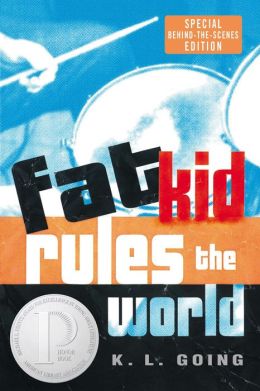
Fat Kid Rules the World by K. L. Going


The Book
This young adult book took my by surprise. I guess maybe it's because I tend to be a little bit prejudiced against young adult books sometimes. There's so many of them that are romantic fluff that I get surprised when I find one that takes a serious topic and handles it beautifully.

This novel doesn't just take one topic. It takes several such as depression, attempted suicide, death of a parent, sibling rivalry, being overweight, bullying, drug addiction, homelessness, true friendship, and the purpose of music. That doesn't even cover all of them. However it's anything but sad and dreary. I found myself laughing dozens of times at Troy's clever observations and hilarious self-depreciating humor. I also ended up caring so much about the characters that I cried for them. There's also a philosophy in the book that will leave me trying to "see through the bullshit" for the rest of my life.

The blurb for this book is:
Troy Billings is seventeen, 296 pounds, friendless, utterly miserable, and about to step off a New York subway platform in front of an oncoming train. Until he meets Curt MacCrae, an emaciated, semi-homeless, high school dropout guitar genius, the stuff of which Lower East Side punk rock legends are made. Never mind that Troy’s dad thinks Curt’s a drug addict and Troy’s brother thinks Troy’s the biggest (literally) loser in Manhattan. Soon, Curt’s recruited Troy as his new drummer—even though Troy can’t play the drums. Together, Curt and Troy will change the world of punk, and Troy’s own life, forever.

Although Troy and Curt are fairly close in age and have the same high school in common, these are the only traits they share. In every other aspect they couldn't be more opposite. Troy is an overweight loser and Curt is considered a local rock legend. Using the phrases "overweight loser" and "local rock legend" cheapens these characters though. They are anything but stereotypes. That's what makes this novel so great. The truth of who they are is what matters in this story. Even Troy's military father defies the stereotype of a cold, hard Marine.

There's also one particular line that stuck with me. Forgive me if it's a paraphrased. "The words I had been waiting to hear my whole life were the ones I needed to give away." There's something so beautifully profound about that. It speaks to me about my own life.

Equally unforgettable is the scene when Troy and Curt are in the restaurant and Curt helps Troy see the world in an entirely different way. I would love to tell you what that is but I never give spoilers in my reviews.

Ultimately the book is a lesson about not giving up on yourself and not giving up on the people you care about. None of these are topics you would expect in a book about being in a punk rock band. When you think of punk music you think of rebellion, anarchy, and destruction. Don't worry. Those things are in there.

My rating and I don't give this many out often: Photobucket

The Movie
I wanted the movie Fat Kid Rules the World to be great too. I especially had high expectations because Matthew Lillard was directing. He was so amazing in the movie SLC Punk that you expect him to really get what the book is about. Unfortunately the movie tended to revert this deep characters back to stereotypes. Troy is a typical fat kid and we just don't get to see inside his mind. This is why we read books though isn't it? Movies just don't show the inner thoughts of people unless there are voice overs. I honestly think a voice over would have given Troy the depth he had in the book.

What was missing the most was the humor of the book. I wanted the movie to show how smart, clever, and perceptive Troy really was but unfortunately the screenwriter just didn't catch it. I don't really blame Matthew Lillard's directing. I mostly blame the screenwriter who on some levels just didn't seem to get the true meaning of Fat Kid Rules the World.

Curt is only a hint of of what he is in the book. The movie version doesn't catch his mannerisms, his hyperactiveness, how dirty and disheveled he really was, or how he was treated like a local rock god. In the movie, Curt was disrespected by his fellow band members and just wasn't treated with the awe that he was in the book. This is what made the book so fascinating. Curt had an image and reputation for being a rock god despite being a filthy, homeless, drug addict. He was an enigma, not a stereotype.

Don't get me wrong. The movie is good, but it could have so much more. It just seemed to care more about plot than it did about character.

It's probably more like 3 1/2 but... Photobucket

Thursday, 14 February 2013

The New Mom's Guide to Living on Baby Time by Susan Besze Wallace with Monica Reed

This book was hit and miss sometimes but overall it is definitely worth the read. It's also a quick read so you can get it done in between baby's naps and feedings.

I had really expected more regarding how to work with my baby's schedule. Instead the book just referred me to another book Secrets of The Baby Whisperer by the late Tracey Hogg. I felt this was a total cop out. I was looking for more advice about working with my baby's routine not just three questions at the end of a chapter on the topic asking my if I prefer a schedule or not to schedule. Hello!? If I didn't want a schedule or routine why in the world would I be reading this book?

I did disagree with the scheduling advice the authors gave to some degree. It seemed to contradict itself at times. In one part they are saying that you need to establish a "routine" because you can't actually schedule a baby but then in another section they talked about a mom who put her baby to bed every night at 10 PM from the very start and he slept until morning. (Yeah right!) This seemed completely out of place with the earlier chapter about letting go of your expectations of life with baby.

It had some great tips about getting out of the house and considering my favorite place in the world is already the mall (with or without a newborn) the tips will work well for me. My library also has reading time called Babies and Books. However, a new mom without these resources (or who hates the mall) might be throwing the book at the wall.

Another complaint I had about the book is the authors talk way too much about having a toddler. The book's title is "The New Mom's Guide" not the "Second or Third Time Mom's Guide." In the end, the tips to "find pockets of time" and "do what works for you" was pretty disappointing. That's just common sense. I don't need to read a book to know that.

Overall though I did like the advice about letting go of "getting things done" and "achieving goals." I tend to be a Type A personality that likes to check things off of my to do list. The advice to let go of that mentality and just enjoy my baby was great. I also gave the book an extra star because it is one of the few books written on this topic.

 My rating Photobucket

Tuesday, 12 February 2013

The Attachment Parenting Book by William and Martha Sears

I heard about attachment parenting a few years ago and assumed it was something that only...well...how do I put this? I thought only weirdos practiced attachment parenting. All I knew about them was that they breastfed their kids until they were old enough to ask for steak and that they all slept in a family bed. I was kind of a jerk and idiot because this is the most extreme of attachment parenting. It turns out there is an attachment parenting spectrum and not all advocates are quite so hardcore.

It also turns out I've been practicing some aspects of attachment parenting for the last 19 years and didn't even know it.

I've always been the type of person who wants to read the material of the originator. While there are dozens of other books on attachment parenting, this book is by the pediatrician Dr. William Sears, who was the first to coin the term "attachment parenting." 

Because I started reading this book with such preconceived ideas about what attachment parenting was, I was pleasantly surprised to learn the original concept wasn't quite so "crunchy granola" for a lack of a better term. Dr. Sears explains his philosophy on attachment parenting and backs it up with science. He expands on the seven basic principles of attachment parenting which he calls the B's:

1. Birth bonding (Rooming in after giving birth and continuing to bond in the early weeks and months)
2. Breastfeeding (However, he respects the choice to bottle feed. In fact, he lacks the Nazi-like attitude that breastfeeding must be done to be a good mother. In fact, Dr. Sears says "Don't let anyone make you feel guilty for not breastfeeding.")
3. Babywearing (Wearing your baby in a carrier or sling)
4. Bedding close to baby (I was surprised to find out that Dr. Sears is not an advocate of the "family bed." He explains that his children did co-sleep with him and his wife but all did so one at a time and eventually moved to their own beds.)
5. Belief in baby's cry (This simply means understanding that a baby's cries are how he communicates his needs. A baby does not cry to manipulate the parent.)
6. Balance and boundries (This means taking care of yourself, your partner, and the rest of your family in balance with taking care of your baby. Boundries means you don't give your child everything she wants, just what she needs and you practice discipline while respecting the child.)
7. Beware of baby trainers (This means you adapt to your baby's schedule as opposed to making your baby fit yours. You feed on demand and avoid methods such as crying it out.)

I was highly impressed with this book. It was a great introduction to attachment parenting and wasn't so hardcore that it completely scared me off. Dr. Sears even explains that you don't have to practice all of the principles to be an attachment parent. Parents will use these different tools to different degrees that works best for their family. I loved how Dr. Sears emphasized that if you don't take care of yourself along with caring for your child, you won't be the best parent you can be. This is truly a holistic approach that takes into consideration every family members needs.

My only complaint is that it doesn't have as much detail about how to practice some of these tools. For example, there are several different types of slings and baby carriers. It takes some practice to learn how to use a sling or carrier safely. This information was not included in the book. Another example was there wasn't any information about where Dr. Sears stands on issues such as cloth vs. disposable diapers or when to start feeding a baby sold food. I would have liked to have seen topics like these included. Perhaps they are in his other book titled The Baby Book. I would also like to know how to apply the principles of attachment parenting to older children which I believe are addressed in The Discipline Book and Creative Parenting.

My rating Photobucket

Sunday, 30 December 2012

2013 Outdo Yourself Reading Challenge


What’s your reading goal for 2013? If it’s to read more books, then this is the reading challenge for you! There have been almost 400 readers who wanted to outdo themselves so far. Are you up for the challenge?

Reading Challenge Details: Runs January 1, 2013 – December 31, 2013 (books read prior to 1/1/2013 do not count towards the challenge).

You can join at anytime. Sign up on The Book Vixen’s blog.

The goal is to outdo yourself by reading more books in 2013 than you did in 2012. See the different levels below and pick the one that works best for you. You can move up a level as often as you’d like but no moving down.

Books can be any format (bound, ebook, audio).

Novellas that are at least 100 pages in length, as well as full-length novels, will count for this reading challenge.

Re-reads and crossovers from other reading challenges are allowed.

Grab the reading challenge button and post this reading challenge on your blog to track your progress. Please include a link back to this sign-up post so others can join the reading challenge too. You do not have to be a book blogger to participate; you can track your progress on Goodreads or LibraryThing.

Levels: Getting my heart rate up – Read 1–5 more books

Out of breath – Read 6–10 more books

Breaking a sweat – Read 11–15 more books

I’m on fire! – Read 16+ more books